
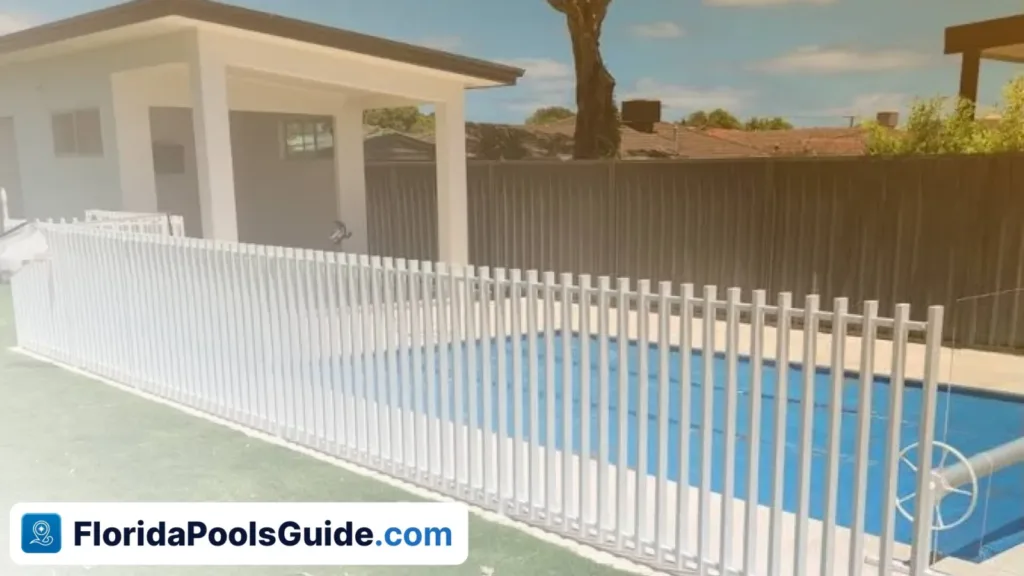
Florida’s pool barrier rules come from one law: the Residential Swimming Pool Safety Act, Chapter 515 of the Florida Statutes. It took effect on October 1, 2000, and it decides whether a new home pool can pass its final inspection. It gives an owner five ways to comply, and one is enough.
This guide follows the statute section by section, with the section number beside each rule so you can check it yourself. It is not legal advice. Your city or county building department applies the law, and a local ordinance can be stricter. Checked against the 2026 Florida Statutes on November 15, 2026.
Florida pool barrier law on one page
- Who it covers: pools, hot tubs and nonportable spas deeper than 24 inches at a detached one- or two-family home or a townhouse of up to three stories (s. 515.25).
- The rule: to pass final inspection, a new residential pool needs at least one of five safety features (s. 515.27(1)).
- 1. Barrier: the pool is isolated from the home by an enclosure that meets the barrier rules.
- 2. Safety cover: an approved cover meeting ASTM F1346-91.
- 3. Exit alarms: on every door and window giving direct access from the home to the pool, rated at least 85 decibels at 10 feet.
- 4. Self-closing doors: every such door self-closes and self-latches, with the release at least 54 inches above the floor.
- 5. Pool alarm: an in-water alarm independently certified to ASTM F2208.
- Barrier rules (s. 515.29): at least 4 feet high outside; nothing a young child can crawl under, squeeze through or climb; set back from the water’s edge; gates open outward, self-close and self-latch, with the release on the pool side out of a child’s reach; nothing climbable beside it.
- Penalty (s. 515.27(2)): a second-degree misdemeanor, waived if within 45 days the pool is equipped and the person attends a drowning prevention class.
Source: Florida Statutes Chapter 515, checked November 15, 2026. Your building department applies the law and may require more. floridapoolsguide.com/florida-pool-fence-law/
Which pools the law covers
Chapter 515 defines a swimming pool as any structure meant for swimming or bathing that holds water more than 24 inches deep. That includes in-ground, above-ground and on-ground pools, hot tubs and nonportable spas (s. 515.25(11)). The pool counts as “residential” when it sits at a detached one-family or two-family home, or at a one-family townhouse no more than three stories high (s. 515.25(10)).
The law does not apply to (s. 515.37):
- public pools, which follow separate state rules;
- portable spas that have a safety cover meeting ASTM F1346-91;
- small temporary pools without motors, such as inflatable kiddie pools;
- farm structures such as stock ponds and watering troughs, and drainage and irrigation works;
- any city or county that has its own residential pool safety ordinance at least as strict. There, the local ordinance is the rule to follow.
The five ways to comply
To pass final inspection and receive a certificate of completion, a new residential pool must meet at least one of these (s. 515.27(1)):
- A barrier that isolates the pool from the home. The pool is separated from access to the house by an enclosure that meets the barrier rules in the next section.
- An approved safety pool cover. A manual or powered cover that meets ASTM standard F1346-91 (s. 515.25(1)). A solar blanket or a leaf cover is not one.
- Exit alarms. An alarm on every door and window that gives direct access from the home to the pool, with a sound rating of at least 85 decibels at 10 feet. The alarm must sound continuously when the door or window is opened or left ajar (s. 515.25(4)).
- Self-closing, self-latching doors. Every door giving direct access from the home to the pool closes and latches on its own, with the release mechanism at least 54 inches above the floor.
- A swimming pool alarm. A device placed in the pool that sounds when someone enters the water, independently certified to ASTM standard F2208. This option was added in 2016.
One feature satisfies the law. Florida’s Department of Health recommends layers instead: supervision, barriers and being prepared for an emergency, because any single layer can fail.
What a compliant barrier must have
If you comply with a barrier, s. 515.29 sets the standard. “Barrier” means a fence, a wall of the house, another wall, or a combination of them that completely surrounds the pool (s. 515.25(2)). It must:
- be at least 4 feet high, measured on the outside;
- have no gaps, openings, indentations, protrusions or structural parts that would let a young child (under 6, in the statute) crawl under, squeeze through or climb over;
- surround the pool on its own, separate from any fence around the yard, unless the yard fence runs along the pool’s perimeter and meets every barrier rule;
- stand far enough from the water’s edge that a child or a frail older person who gets through does not fall straight in;
- have nothing beside it that could be used to climb over it, such as a permanent structure or equipment.
Gates must open outward, away from the pool, close on their own, and latch on their own, with the release on the pool side and out of a young child’s reach (s. 515.29(3)).
A wall of the house can form part of the barrier only if it has no door or window that opens onto the pool (s. 515.29(4)).
An above-ground pool’s own walls can be the barrier, or carry one, if they meet the same rules. Its ladder or steps must then be removable or lockable, or sit inside a compliant barrier (s. 515.29(2)).
Does a screen enclosure count?
Chapter 515 does not mention screen enclosures by name. A screen cage is an enclosure, so it can serve as the barrier if it meets every rule in s. 515.29: at least 4 feet high, no openings a child can get through, and doors that open outward, self-close and self-latch with the release out of reach.
Most Florida cages are attached to the back of the house, and the house doors open straight into the cage. In that layout the cage does not separate the pool from the home, and the house wall has doors onto the pool, which s. 515.29(4) rules out. In our reading of the statute, the cage alone then does not meet the barrier option. The house doors into the cage also need exit alarms or self-closing, self-latching hardware (options 3 or 4), or the pool needs another option. Ask your building department how it applies this to your layout before relying on the cage.
Pricing a new enclosure? Our pool cage cost guide covers that side.
Penalty
Failing to equip a new residential pool with at least one of the five features is a misdemeanor of the second degree (s. 515.27(2)). The statute adds a way out: there is no penalty if, within 45 days of the arrest, summons or notice to appear, the pool is equipped and the person attends a drowning prevention education program. If no program is offered within those 45 days, attendance is waived.
Buying a new home with a pool
A licensed pool contractor, or a builder or developer selling a new home with a pool, must give the buyer a document setting out the Chapter 515 requirements and a copy of the Department of Health’s publication on drowning prevention and pool ownership (s. 515.33). If you bought a newly built home with a pool and did not receive these, ask for them.
Older pools, renovations and insurance
Chapter 515 applies at final inspection of a new pool, and it took effect on October 1, 2000. The statute itself does not order owners of older pools to retrofit. A local ordinance can say otherwise, so ask your building department two questions: whether your city or county requires barriers on existing pools, and whether a permit for work on your pool would bring the barrier rules into play.
Insurance is separate from the law. Some homeowner’s policies set their own conditions for pools. Read the pool section of your policy, and if it asks for a barrier, make sure yours meets it.
Whatever the law requires of an older pool, the risk to a child is the same. Florida’s Department of Children and Families states that Florida loses more children under the age of 5 to drowning than any other state. Bringing an older pool up to these rules is usually a small job: a compliant gate latch, door alarms, or a fence.
A seasonal checklist
- At least one of the five features is in place, and ideally more than one.
- Any fence or cage is at least 4 feet high on the outside, with no gaps a child could get through and nothing to climb.
- Every gate and cage door swings shut and latches by itself. Test each one: open it fully, let go, and watch it latch.
- Door releases are at least 54 inches above the floor; gate releases are on the pool side, out of reach.
- Exit alarms sound when the door opens, and nobody has left them switched off.
- Chairs, coolers, planters and pool equipment are kept away from the barrier.
- A safety cover, if you use one, is the certified kind and is put back on after every swim.
- Your building department has confirmed what it requires locally.
Springs weaken and latches loosen. A barrier that passed inspection years ago may not work today, so test it every season.
If you are building a new pool, ask your contractor which of the five options the plans use. It is one of the questions worth asking before you sign.
FAQ
What does Florida pool fence law require?
Under Chapter 515, a new residential pool must have at least one of five safety features to pass final inspection: a barrier that isolates the pool from the home, an approved safety cover, exit alarms on doors and windows leading to the pool, self-closing and self-latching doors with the release at least 54 inches up, or an in-water pool alarm certified to ASTM F2208.
How tall does a pool fence have to be in Florida?
At least 4 feet high, measured on the outside, with no gaps or footholds a young child could use. Gates must open outward, self-close and self-latch, with the release on the pool side out of a child’s reach. A local ordinance can require more.
Does a screen enclosure satisfy the law?
It can serve as the barrier if it meets every barrier rule. But where the house doors open straight into the cage, the cage does not separate the pool from the home, so those doors also need exit alarms or self-closing, self-latching hardware, or the pool needs another of the five options. Your building department decides how it applies to your home.
Do hot tubs and spas count?
Yes. The law covers any residential structure for swimming or bathing that holds water more than 24 inches deep, including hot tubs and nonportable spas. Portable spas with a safety cover meeting ASTM F1346-91 are exempt.
What is the penalty?
Failing to equip a new residential pool is a second-degree misdemeanor. There is no penalty if, within 45 days, the pool is equipped and the person attends a drowning prevention education program.
Sources
More articles
Differenza Pools: How Two Brothers Built a Trusted Apollo Beach Pool Builder
Brothers Tony and Devin Palazzo went from building homes for HGTV's 100 Day Dream Home to founding Differenza Pools, a boutique Apollo…
Pool Pump Repair: What You Can Fix, and What You Can’t
Pool pump repair guide for Florida: what the noises and symptoms mean, the DIY-safe fixes, the electrical line you don't cross, and…

Next Level Pools and Spas: Success Story
Back in the 1980s, Robbie didn’t expect his future to be in any way connected to pools. He wanted to be a…